Start with Coverage and Wear
A full wig covers the crown, sides and back of the head, while partial pieces cover selected areas and rely on surrounding natural hair for blending. The amount of hair to contain can affect which cap shape feels manageable beneath a full wig. A wig worn for an evening may call for a different preparation and storage routine from one worn most days. Parting, hairline visibility and how often you want to restyle also influence which options suit your routine.
Coverage needs
A full wig covers the scalp from the front hairline across the crown and down over the sides and nape. It can provide a consistent outline when you want all visible hair covered, whether your natural hair is short, long or sparse. A partial piece, such as a crown topper, covers only a defined area; the surrounding hair remains visible and must blend in colour, texture and length.
Think about where coverage is needed before selecting a cap. If you want coverage over the entire head, choose a full-wig cap rather than a piece designed only for the crown or parting. If you need coverage in one area and have enough surrounding hair to blend, a partial option may feel less enclosing. Full coverage can be simpler when natural hair varies in density across several areas, while a partial piece may leave more of your own hair available to style.
The amount and length of natural hair also matter. Short hair or a close-cropped cut usually needs little containment, while longer hair may need to be divided into flat plaits or pinned into a low, even arrangement before the wig goes on. A bulky knot at the crown can create a visible ridge and make the cap sit unevenly. If you have substantial hair to contain, look for a cap with enough internal room and a secure, comfortable fit; if your hair is very short, excess cap volume may feel unnecessary. For wigs in the UK, assess coverage and containment together rather than choosing by appearance alone.
Wear frequency and routine
For occasional wear, such as a few events each month, allow extra time to arrange natural hair beneath the cap and check the finished look in daylight before leaving. After removal, let the wig air fully, then store it on a stand or in its supplied box so the shape is supported and dust is kept off. A wig should be completely dry before it is covered or put away; storing it damp can leave fibres flattened or tangled.
Frequent wear makes a repeatable routine more useful. Keep the same preparation steps each day, remove the wig gently rather than pulling at the front, and detangle from the ends upwards with a suitable comb or brush. For longer styles, hold the hair above the area being detangled to reduce tugging. A second wig can make rotation possible, giving each piece time to air between wears, though this is an added cost and may not be necessary for someone who wears a wig only occasionally.
Washing frequency depends on wear time, perspiration, styling products and the wig’s care instructions. Some wearers use a wash after roughly six to eight wears as a starting point, then adjust if the fibres feel coated or the cap needs freshening; follow the maker’s instructions because materials differ. Frequent washing can shorten the time a style stays neat, while leaving product build-up can make fibres look dull. Choose a routine you can maintain: occasional wear may need only careful storage between uses, whereas near-daily wear calls for regular detangling, airing and planned cleaning.
Styling expectations
Start with the finish you want at the front and parting. If you plan to wear hair swept away from the face, a lace front may give a less obvious transition at the hairline, but it does not automatically allow a part anywhere across the scalp. A monofilament section can support a more flexible-looking part within that section; its size and position determine how much freedom it provides. If you keep a fringe or a fixed side part, a simpler cap may meet your needs without paying for features you will rarely use.
How often you expect to restyle matters as much as the look. Human hair can generally be reshaped with heat and styling tools, so it may suit someone who wants to change a smooth finish into waves or adjust the part regularly. That flexibility usually involves more hands-on styling and care. Standard synthetic fibres tend to hold their set shape after washing, which can save time for someone who wants the same style each wear, but offers less scope for changing it. Heat-friendly synthetic fibres may allow some heat styling only within the manufacturer’s stated temperature limit.
Match the cap and fibre to your preferred level of realism and effort. If a visible part is central to the look, prioritise a cap feature that supports the part you actually wear rather than assuming every lace or monofilament design behaves the same way. If you rarely change your style, a ready-shaped synthetic option may be more convenient; if frequent restyling matters, human hair may justify its greater upkeep. Choosing a wig style works best when the desired hairline, parting and weekly styling time are considered together.
Wig Fibres and Their Trade-Offs
The fibre affects how a wig can be styled, how it responds to heat and what care it needs between wears. Human hair, manufactured synthetic fibres and blends each behave differently, so the right choice depends on the balance of styling freedom and routine you prefer. Labels matter: synthetic fibres vary, and blends do not all contain the same proportions of human and synthetic hair. Comparing the fibre details before choosing among wigs in the UK helps set realistic expectations for the finished style.
Human hair
Human-hair wigs use real hair rather than a manufactured fibre. Their strands can usually be reshaped with heated styling tools, allowing changes such as smoothing a wave or adding curls. The response depends on the hair’s texture and processing, as well as the tool and technique used; a wig should not be treated as if every fibre has identical heat tolerance. Check the care information supplied with the individual piece before applying heat.
Compared with synthetic hair, human hair offers more scope for restyling, but its appearance can shift with styling and handling. Individual strands may differ in texture, tone and direction, and these variations can make the finish less uniform than a factory-set synthetic style. Human hair wigs in the UK may also differ according to the source hair and any processing, so the label and product description are more informative than the fibre name alone.
Care takes more attention than simply restoring a set style. Use products intended for wigs or suitable gentle hair care, detangle carefully from the ends upwards, and avoid rough rubbing that can tangle or stress the strands. Washing and drying can alter the arrangement, so allow time to style the hair again when needed. This fibre suits wearers who value the ability to change the look and are prepared to manage styling and care as part of their routine.
Synthetic hair
Synthetic wigs are made from manufactured fibres, not human hair. The fibre is formed and styled to create a particular finish, such as a straight, curled or waved look. Because the style is built into the fibre, the finished shape is generally more consistent from one wear to the next than a style that has been repeatedly reshaped by hand. Handling and washing can still disturb the arrangement, so follow the product’s care instructions.
Heat compatibility depends on the specific synthetic fibre. Conventional synthetic hair may be damaged or altered by heated styling tools, while some heat-friendly synthetic wigs are designed for limited heat styling. There is no single safe temperature that applies to every product: check the manufacturer’s stated limit and instructions before using a hot tool, and do not assume that all synthetic fibres are heat-friendly. If the label does not confirm heat compatibility, avoid applying direct heat.
Care typically involves gentle detangling and washing according to the fibre’s directions, rather than treating the wig like human hair. Avoid vigorous brushing, which can disrupt curls or waves, and let the wig dry as directed so its set shape is not pulled out of place. Compared with human hair, synthetic hair usually offers less freedom to restyle, but its pre-set finish can reduce the need to recreate a style after each wash. It is a practical option when keeping the same defined shape is more important than frequent changes.
Human-hair blends
A human-hair blend combines human hair with synthetic fibre, but the proportions and fibre types vary between products. That composition affects how much restyling is possible, whether heat can be used, the care routine and how consistently the style holds. Read the fibre-content and care labels rather than assuming every blend behaves alike.
| Factor | Human hair | Synthetic hair | Human-hair blend |
|---|---|---|---|
| Styling flexibility | Can generally be reshaped with styling tools; texture and processing affect the result. | Usually retains its manufactured style; restyling options depend on the fibre. | Falls between the two; the proportions and fibre types determine how much reshaping is practical. |
| Heat compatibility | Can generally be styled with heat, but suitable settings depend on the hair and care instructions. | Heat use depends on whether the specific fibre is labelled heat-friendly and on its stated limit. | Follow the blend’s own instructions; compatibility depends on its synthetic component and composition. |
| Care demands | Needs careful detangling, washing and restyling to maintain the chosen look. | Needs gentle handling to preserve the manufactured shape; follow fibre-specific washing directions. | Care depends on both components; use the product instructions rather than human-hair-only routines. |
| Style consistency | Can vary with restyling and handling; strands may differ in texture and tone. | The set style is generally consistent between wears when handled as directed. | Combines characteristics of both fibres, with the resulting consistency shaped by the blend ratio. |
A blend is not a fixed middle ground: a product with a greater share of one fibre may behave more like that category, while the other component still influences care and styling. Check the stated composition and any heat guidance before choosing. This comparison is especially useful when a wig’s appearance appeals to you but you want to know whether its fibre will suit your usual styling routine.
Cap Construction and Fronts
A wig cap is the base that supports the hair, and its construction can affect airflow, contour, visible parting and styling options. Open wefts, lace and monofilament sections each create a different balance between coverage and flexibility. Features may be combined, so a lace front can sit on a cap with wefts or a monofilament crown. The effect depends on the size and placement of each feature, not simply its name.
Common cap features
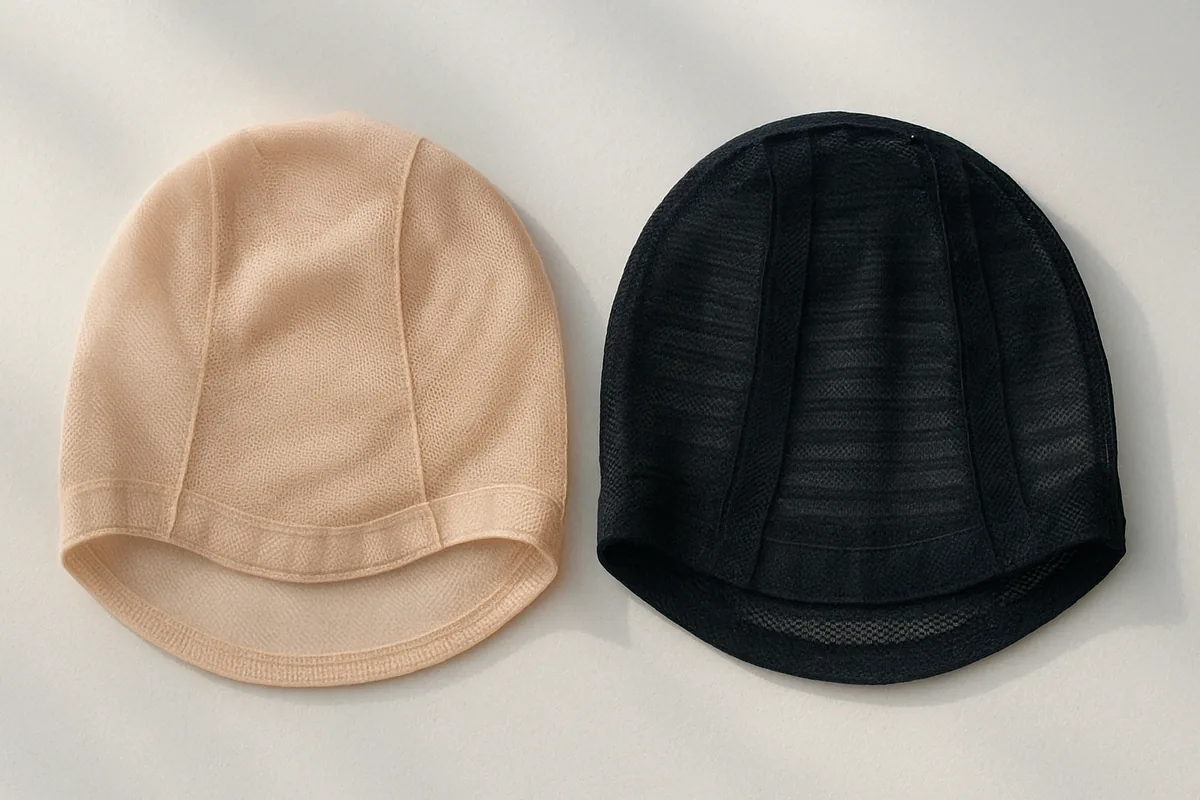
The cap base holds the hair in place and sits against the head; designs range from covered fabric to open constructions with rows of wefting. Wefts are strips of hair sewn onto the cap. The spaces between open rows can let air pass through more readily than a fully covered base, while the rows give the hair a set direction and can show through if the hair separates over them.
Because hair on a weft follows the row where it is attached, this construction usually offers less freedom to create a new part than a hand-tied section. The direction of the rows also influences how the hair falls at the crown and sides. A cap with a defined top or parting panel may allow more movement in that area, while the rest of the style remains guided by its wefts.
Many caps include adjustable straps near the nape, often with hooks that fasten into several slots. They provide a small amount of adjustment to the cap’s circumference, but cannot compensate for a base that is substantially too large or too small. Ear tabs sit in front of the ears and help keep the cap’s sides in position; some designs include stays that can be gently shaped to follow the temples.
These features work together rather than guaranteeing a particular fit. An open-wefted base may feel less enclosed, while a covered base can create a smoother contour beneath the hair. Strap placement, ear-tab shape and the stiffness of the base all affect how the cap sits, so the same feature can feel different across designs.
Lace fronts
A lace front has a fine mesh panel along the front edge of the cap, with hairs attached to the mesh to form the hairline. The sheer material can make the transition between forehead and hair appear less abrupt than a solid fabric edge. The result depends on the lace colour, how closely it suits the wearer’s skin tone, the density and direction of the hairs, and how the front sits when worn.
The lace panel can support styling that exposes some of the front hairline, including a swept-back fringe or a side part that begins near the forehead. It does not make every part of the cap freely partable: hair behind the lace follows the construction underneath, such as wefts or a monofilament section. A lace front therefore changes the appearance and styling options at the front, not necessarily across the crown or sides.
Fit also affects how the lace lies. If the front edge shifts, lifts or wrinkles, the mesh may become more noticeable; a stable cap position helps the hairline look consistent. Lace fronts differ in panel depth and width, and those dimensions determine how much of the front edge is made from mesh. A lace-front design is not the same as a full-lace cap, which uses lace across a broader area.
In practice, lace fronts trade a less defined-looking edge for a delicate mesh area that must sit smoothly. Some designs are intended to be trimmed, while others arrive with a finished edge; follow the maker’s instructions rather than assuming all lace can be cut. The front may offer more freedom to move hair away from the face, but the rest of the cap still sets limits on parting and direction.
Monofilament sections
Monofilament is a fine, sheer mesh used in a defined area of the cap, commonly at the crown or along a parting. Individual hairs are attached through the mesh, so the visible base can resemble scalp beneath the hair. A monofilament section can make a part look less like a sewn row than a standard wefted area, although the appearance varies with mesh colour, hair density and how the strands are arranged.
The size and position of the panel determine how much styling flexibility it provides. A monofilament part supports movement within that parting area; a crown panel gives a broader zone in which the hair can be shifted. Neither feature necessarily allows unrestricted parting over the entire cap. Hair outside the panel may still be attached to wefts, which guide its direction and limit where it can be separated.
Construction also influences how the cap contours to the head. A monofilament panel can be soft and conformable, but the surrounding materials, seams and cap shape remain important to the overall fit. Its presence alone does not mean the cap will suit every head shape or stay in place without adjustment. Compare the panel’s location with the hairstyle you plan to wear, especially if the part is a prominent feature.
| Construction | Visible effect | Parting and direction | Fit consideration |
|---|---|---|---|
| Open weft rows | Rows may be visible if hair separates over them | Hair follows the sewn row direction | Open spaces can allow airflow through the base |
| Monofilament part | Sheer mesh beneath individual hairs at the part | Movement is concentrated in the parting panel | Panel and surrounding cap shape both affect contour |
| Monofilament crown | Scalp-like appearance across the crown panel | Hair can be repositioned within the panel | Wefts elsewhere may still guide the style |
A larger panel can provide more room to reposition hair, while a smaller parting panel keeps that flexibility focused. Check the actual panel placement against the intended part and crown direction; the construction label alone does not describe how much of the style can be changed.
Fit, Size and Length
A comfortable wig starts with measurements that match the maker’s size chart, while a secure fit depends on how the cap sits when worn. Hair length is a separate specification: it describes the fibres, not the dimensions of the cap. Measuring your head for a wig gives you a useful starting point, but chart labels and measuring methods can vary between makers. Checking the fit and the length description helps you compare styles more accurately.
Measuring your head
Use a flexible tailor’s tape and measure against the head, not over a bulky hairstyle. Keep the tape level and snug without pulling it tight; record each result in both centimetres and inches if the maker’s chart uses either unit.
- Circumference: Start at the centre of the front hairline, bring the tape behind one ear, around the nape at the point where the hairline ends, behind the other ear, and back to the start.
- Hairline to nape: Place the tape at the centre of the front hairline, follow the head over the crown, and finish at the centre of the nape hairline.
- Ear to ear across the forehead: Begin at the hairline just above one ear, run the tape across the front hairline, and end at the matching point above the other ear.
- Ear to ear over the top: Start just above one ear, pass the tape over the crown, and finish just above the opposite ear; use this path if the chart lists it separately.
- Record consistently: Repeat each path once, noting the measurement and the route used; if the readings differ, check that the tape stayed level and was not stretched.
Compare every measurement with the same maker’s chart, matching the chart’s named paths rather than relying on a size label alone. Some charts give a circumference only; others also ask for front-to-nape and ear-to-ear measurements. If your figures fall between listed sizes, check the maker’s guidance and whether the cap has adjustable straps before choosing. Wig sizing and fit are not fully standardised, so a “medium” label from one range may not match another. A chart is most useful when your tape follows its stated landmarks and your measurements use the same units.
Assessing cap fit
A well-fitting cap should sit evenly along the front hairline, above the ears and at the nape, without shifting when you turn your head. Check that the front edge follows your hairline rather than sitting noticeably too far forward or exposing a gap. The ear tabs should rest in a balanced position, and the nape should feel secure without riding upwards. If the cap pulls the skin, creates persistent pressure points or leaves an obvious space at the sides, the fit may not suit your head shape or size. Try the cap with the hair arranged as you would normally wear it beneath a wig. Smooth any bulky sections so they do not push the cap out of position, then check the fit while looking down and turning gently from side to side. The cap should stay in place without relying on a tight pull at the front. Avoid judging fit from the first moment alone: allow the cap to settle, then reassess the hairline, ear area and nape. Cap size describes the overall dimensions selected from the maker’s chart; adjustable features refine how that size sits. Adjustable wig straps, commonly positioned near the nape, can take up a small amount of looseness or add ease within the cap’s range. They cannot reliably turn a substantially oversized cap into a smaller one, or correct a cap that is too small. If tightening the straps distorts the cap or makes the edges uncomfortable, try another size rather than using the adjustment to compensate.
Reading hair length
A listed wig length usually refers to the hair from the crown or top of the head to its longest ends, rather than the distance from the cap edge. Measurement conventions vary, so check where the maker places the starting point and whether the figure describes the longest layer. A length in inches or centimetres describes the hair when measured along its strand; it is not a cap measurement and does not indicate the size of the wearer’s head. Straight styles tend to show their stated length more directly because the fibres fall close to their full strand length. Waves and curls occupy more space and spring back, so the visible drop can look shorter than the same listed length in a straight style. Some makers measure textured hair in its natural shape, while others stretch or straighten a section for measurement. When comparing two listings, check whether their methods match instead of treating the numbers as directly equivalent. Layering also changes the outline: a long wig with short face-framing layers may look shorter around the face while retaining longer hair at the back. Styling can alter the apparent length further; brushing out waves adds width, while defined curls keep the ends closer to the head. Look for a length guide or product photographs showing the style on a model, and compare the listed point of measurement with your own height and preferred fall. This helps distinguish a true length difference from the effect of curl pattern, layers or styling.
A Practical Wig Selection Checklist
A useful shortlist starts with what the wig needs to do in everyday life, rather than with a particular look. Coverage, wearing frequency and the time available for styling all affect which options are practical. Fibre and cap construction involve trade-offs in appearance, upkeep and feel, while accurate measurements help you compare fit. Use the checklist below to keep those priorities together when considering how to choose a wig.
Selection checklist
Work through each choice in order, noting which features are essential and where you can be flexible.
- Coverage: Decide whether you want full coverage or need to conceal a particular area; the answer helps set the cap and hairline features to consider.
- Wear frequency: For daily wear, prioritise a comfortable, manageable option that suits your routine; for occasional use, you may accept more styling preparation.
- Fibre: Compare the finish and upkeep you prefer: human hair offers more styling flexibility, while synthetic fibres generally hold their set style with less daily work.
- Cap construction: Choose features for the areas that matter to you, such as a lace front for a less defined-looking hairline or a monofilament top for parting flexibility.
- Measurements: Measure your head using the maker’s guide, then compare the result with its size chart; adjustable straps can fine-tune fit but cannot correct a substantially wrong size.
- Styling preferences: Consider whether you want a ready-to-wear shape or expect to restyle it, and whether your preferred length and parting suit your daily routine.
- Care routine: Check the fibre’s washing and drying instructions, suitable products and storage needs; choose a wig whose upkeep fits the time and tools you have.
Treat non-negotiables, such as coverage and a secure fit, separately from preferences like length or parting. If low-effort daily wear matters most, narrow the shortlist to easy-care fibres and construction that feels comfortable; if styling freedom comes first, compare options that allow the looks you expect to create.
Fit, Size and Length: A Practical Wig Selection Checklist
A wig choice is strongest when coverage, routine, fit and styling goals are considered together rather than as separate features. A preference for a particular fibre or front may need to give way to a secure fit or the coverage required for daily wear. Measurements help narrow the cap options, while the intended style affects both length and how the wig sits. The combinations below show how to weigh these factors without treating one construction as right for everyone.
How the choices work together
Start with the area to be covered and how often the wig will be worn. Someone seeking full coverage every day may prioritise a comfortable, stable cap and a routine they can maintain; occasional wear or coverage limited to the crown may leave more room to choose by appearance. For wigs for hair loss, note whether the hairline or parting will be visible, since that affects which cap features matter. These needs set boundaries before fibre or styling preferences narrow the options.
Wear frequency can also shape the fibre decision. Human hair can be restyled, while synthetic fibres generally retain their set shape; the more often you plan to change the look, the more relevant that difference becomes. Consider the time available for styling alongside the desired result, rather than choosing on fibre alone. A lace front may suit a style that exposes the hairline, whereas a monofilament section can be relevant when a visible part is part of the look. Either feature still needs to work with the coverage and daily routine you have identified.
Measurements then connect those preferences to a workable cap size: a style that looks suitable on a chart may feel insecure if the cap does not correspond to your head measurements. Check the cap’s adjustment range and assess the fit before settling on a length or silhouette. For example, if you need full coverage, expect frequent wear, prefer low-effort styling and want a short style with a covered hairline, you could first filter for a suitable measured cap and a shape-retaining fibre, then compare front designs that meet the coverage need. If you instead want a changeable, long style with a visible part, flexibility in restyling and an appropriate parting feature may take priority. These are different routes through the choices, not rankings of particular models.