What a Hair Topper Covers
A hair topper is designed to cover a selected area, not the entire scalp. Its suitability depends on the size and position of that area, as well as where the wearer has hair available for attachment. A crown piece and a part-line piece serve different coverage needs, even when their dimensions are similar. The hairpiece’s position helps distinguish partial coverage from a full wig.
Partial Coverage and Full Wigs
A hair topper is a partial-coverage hairpiece worn over the wearer’s own hair. It conceals a selected zone, such as the crown or part, while the wearer’s natural hair remains visible around the covered area. The piece is attached within that localized zone, so it is intended to work with hair still present on the head rather than cover the scalp from edge to edge.
A full wig covers the whole head, including the areas that a topper leaves exposed. Its coverage extends around the sides and back as well as across the top; a topper covers only the portion its base is designed to span. This difference affects how much of the wearer’s own hair remains visible and where the hairpiece is positioned.
For example, someone seeking to conceal a small crown area may consider a topper if surrounding hair can remain uncovered. If coverage is needed across the entire head, a full wig is the more relevant category. The choice is about coverage extent: a topper supplements hair in one region, whereas a wig provides head-wide coverage. Neither term describes a specific base construction or fibre; those are separate features to compare when reviewing a product.
Coverage Area and Suitability
Suitability depends on whether the topper’s base dimensions cover the area of concern and leave suitable hair where it needs to attach. Consider both the length and width of the area, rather than relying on a product label such as crown or top coverage.
- Crown: If the area needing coverage is confined to the crown, a compact piece may suit it, provided its base spans the sparse zone and reaches hair suitable for attachment.
- Part: If visibility follows a narrow part line, consider a piece whose coverage extends along that line without adding unnecessary width over dense hair.
- Broader top: If thinning extends from the front toward the crown, a wider, longer coverage area may be appropriate, if enough suitable hair remains for attachment.
- Front hairline: If coverage needs begin close to the front, check that the selected piece reaches that area while its attachment points can still connect to available hair.
- Limited attachment hair: If little hair is available around the area, a piece requiring several attachment points there may not provide a suitable fit.
Measure the area that needs coverage and compare it with the product’s stated base dimensions. A piece that is too small may leave part of the target area uncovered; one that extends beyond it may sit over hair that does not need concealing. The surrounding attachment hair matters just as much as the covered zone.
How a Topper Sits on the Head
The base rests over the selected coverage area, with its front and side edges positioned in relation to the wearer’s hairline and natural hair. Its parting should align with the intended part rather than sit noticeably to one side; even a small shift can make the part appear displaced. The edge should meet the surrounding hair where it can be blended with the wearer’s own hair, not extend well beyond the intended coverage zone.
Attachment points sit within the chosen area and connect the piece to available natural hair. When positioning it, check the front edge, part line, and perimeter together: a correctly aligned part can still look misplaced if the base is shifted toward the crown or forehead.
Bases and Attachment Methods
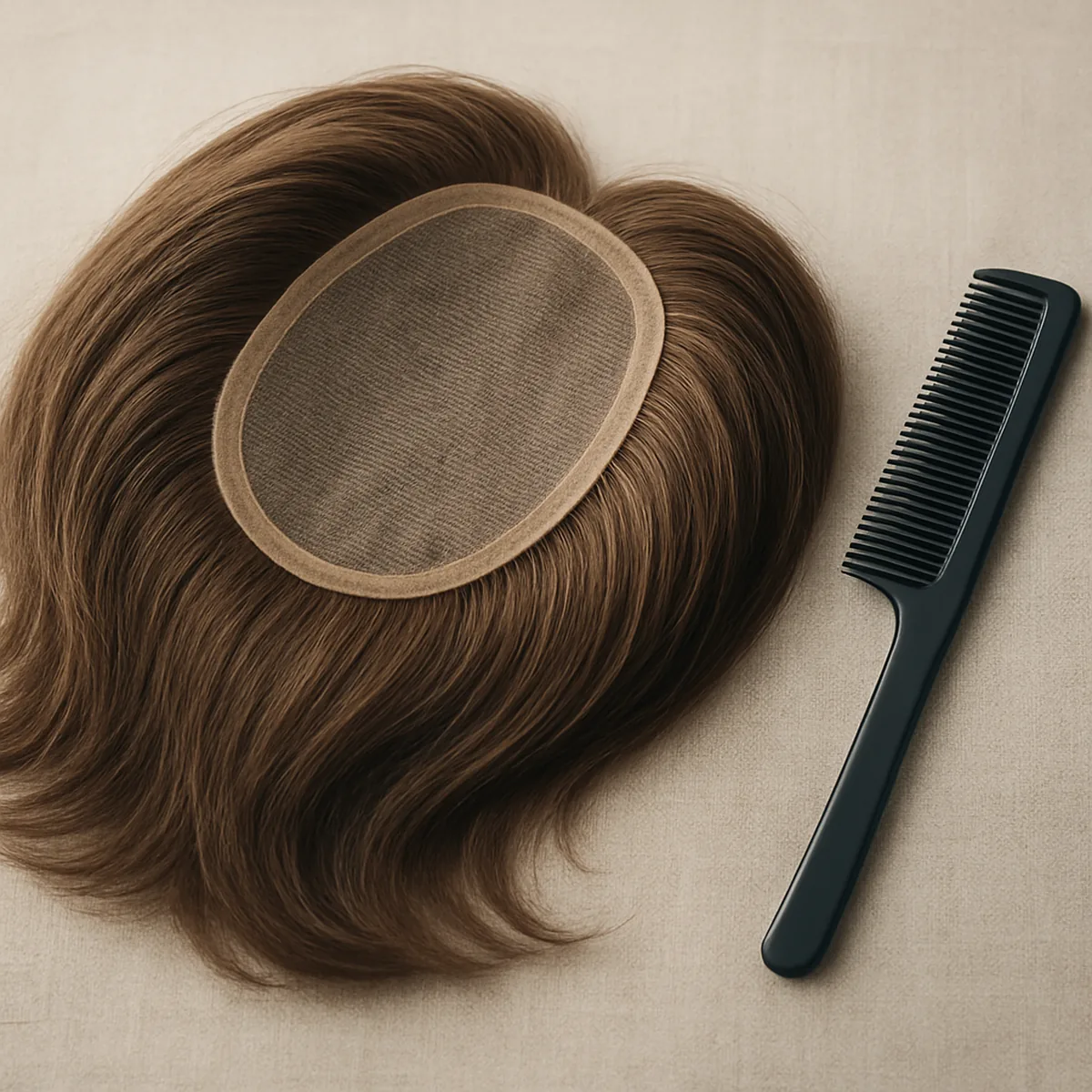
A topper combines a base, which holds the hair, with an attachment method that keeps it positioned on the head. The construction can affect how much scalp-like detail is visible, how air moves through the base and which styling choices are practical. Clips are one common way to secure a topper, while lace, monofilament and other materials describe base construction rather than a guaranteed fit. Hair density, base shape and the location of the attachment points all matter when comparing hair topper base types. Product specifications and close-up photos help clarify how a particular design is made.
Clip-In Attachment
Small pressure clips sewn or otherwise fixed to the underside of a topper fasten around sections of the wearer’s own hair. They are commonly placed near the front, sides and back edges, though the number and position vary by design; check the underside photo or product description rather than assuming a standard layout. To attach one, open each clip, gather a small section of hair at its intended point, close the clip, then check that the base lies flat without pulling.
Clip-in hair toppers can be taken off without removing adhesive, making them convenient for daily wear and storage. Their position is adjustable, but shifting clips too far from the intended points can distort the base or leave the coverage area misplaced. Secure attachment also depends on having enough suitable hair beneath each clip: very fine, sparse or fragile hair may not anchor it well, and a clip pressing repeatedly on one small area can feel uncomfortable. If a clip pinches, loosen it and reposition the topper rather than forcing it closed.
For a natural result, arrange the base over the area needing coverage before closing clips, then blend the wearer’s hair around the edges. The base construction still determines how the top looks and how it should be cared for; clips describe the fastening, not the material or finish.
Lace Bases
A lace base uses a fine, open mesh as the foundation, with individual hairs commonly knotted or ventilated through its openings. The visible part can appear less dense than a solid base because the mesh allows glimpses of the surface beneath it. This may help create a natural-looking part, particularly when the lace shade and the wearer’s scalp tone are compatible, but the effect depends on the lace, hair density, lighting and how the topper is positioned.
The open construction is light and permits airflow through the mesh, although an open base does not by itself ensure a cool or comfortable fit. Hair coverage depends on the overall dimensions and hair placement: lace at the top can provide a parting area while other portions of the base may use a different material. A lace base hair topper can therefore differ considerably from another lace model in coverage and edge construction.
Fine mesh calls for gentle handling. Avoid snagging it with comb teeth, fingernails or rough storage surfaces; support the base while detangling and follow the maker’s washing instructions. Pulling at individual hairs can loosen knots or damage openings, so use light strokes and do not treat lace like a sturdy fabric. Its lightness and parting appearance may suit someone prioritizing a less opaque top, while durability and care depend on the specific mesh and workmanship.
Monofilament Bases
Monofilament is a fine, transparent synthetic mesh used as a base material. Hairs are typically hand-tied through the mesh, so they can move more independently than hair attached in a continuous weft. This construction can make the scalp visible between strands and allow the part to be directed within the monofilament area; the available parting space is limited to the dimensions of that area, not necessarily the entire base.
A monofilament hair topper may have a single monofilament panel, a larger top, or a panel combined with other materials around its perimeter. More hand-tied area can offer greater flexibility in arranging the hair, while the base’s shape and dimensions determine which portion of the head it covers. Compare the product’s actual base measurements and panel layout: the word “monofilament” alone does not specify coverage, density or how naturally the part will blend.
Because strands are tied individually through a mesh, avoid forceful brushing at the roots and do not tug hair through the base while detangling. Work from the ends upward, supporting the hair close to the base, and use the care method specified for the fibre. Compared with a closed, solid panel, monofilament exposes more of the underlying surface; compared with a wefted section, its hand-tied area usually permits more flexible parting, but requires careful handling.
Other Base Constructions
Silk, polyurethane and wefted sections create different trade-offs in scalp appearance, airflow and styling. A topper may use one construction throughout or combine materials—for example, a monofilament top with a wefted perimeter—so check the construction map and care directions.
| Construction | Structure and appearance | Ventilation and styling | Coverage and care |
|---|---|---|---|
| Silk | Hair is routed through layered silk material so knots can be concealed beneath the top layer; the surface can give a scalp-like appearance. | The covered construction is less open than mesh; parting is generally limited to the silk panel’s design. | Panel dimensions set the area with this finish; handle and wash according to the fibre and maker’s instructions. |
| Polyurethane (PU) | A thin, smooth synthetic perimeter or panel; tape or adhesive may be applied to compatible PU surfaces. | Solid PU does not ventilate like open mesh; placement and styling depend on the topper’s shape and attachment design. | Often used at selected edges or sections rather than across the whole base; clean residue only as directed. |
| Wefted sections | Rows of hair are sewn onto narrow strips, leaving spaces between rows. | Spaces allow airflow, while hair direction follows the row layout and offers less free parting than hand-tied mesh. | Weft placement contributes to coverage and volume; detangle gently so combing does not catch the stitched rows. |
These constructions are not interchangeable labels for fit: base dimensions, edge design and the location of any open or solid panels determine how a topper sits and what styling it supports. A mixed base can balance a defined parting area with more open or reinforced sections, so assess the complete layout rather than one material name.
Human Hair, Remy and Synthetic Fibres
A hair topper’s fibre affects how its strands move, respond to styling and need to be maintained. Human hair and synthetic fibre are different material categories, while Remy describes sourcing or processing associated with hair. Labels can help identify what a topper contains, but they do not guarantee identical behaviour across products. Check the maker’s care directions before washing, applying heat or using colour products.
Human Hair Fibre
Human hair toppers use hair as their fibre material, so the strands can move and fall in ways familiar from natural hair. Movement and finish still vary with the hair’s condition, texture, processing and construction; two human hair pieces may not respond alike. A straight texture may need a different styling approach from a curl pattern, and handling can change how either looks over time.
Heat styling is possible for many human hair fibres, but the permitted tools and settings depend on the product. Follow its stated temperature limit, use a heat protectant only if compatible with the maker’s directions, and test a discreet section before styling a larger area. Repeated heat can alter the fibre’s condition, so frequent high-temperature styling may shorten the time it keeps its intended look.
Colour treatment also has limits. Existing colour, prior processing and the condition of the hair affect how it takes dye or lightener, and a result cannot be assumed from the fibre label alone. Chemical colour work may be difficult to reverse; seek guidance from a colourist experienced with hairpieces before treating the topper, and do not assume a shade can be lifted safely at home.
Washing and styling take ongoing care: detangle gently, use products suited to the piece, and let it dry as directed before reshaping. Human hair can require restyling after washing because its finish is not necessarily retained in the same way as a set synthetic style. Follow product-specific instructions rather than relying on a routine intended for natural hair growing from the scalp.
Synthetic Fibre
Synthetic toppers are made from manufactured fibres rather than human hair. The fibre may be designed to hold a particular texture or shape, but the result depends on its formulation and construction. A label saying “synthetic” alone does not tell you how soft, shiny, flexible or durable a specific piece will feel; inspect the product details and care directions for that information.
Heat tolerance is fibre-specific. Some synthetic fibres are not designed for heated tools, while others are sold as heat-friendly and have a stated limit. Use a curling iron, straightener or heated brush only when the manufacturer explicitly permits it, and stay within the stated setting. A familiar temperature used on human hair should not be assumed safe for synthetic strands.
Styling options may be limited compared with human hair. A synthetic topper may retain its manufactured shape after washing, so changing its curl or wave with heat may not be possible. Brushing technique also matters: use the tool and method specified for the fibre, since pulling or rough handling can distort strands or damage the style. Do not cut or reshape a piece unless you are comfortable working with that construction.
Care products and washing directions vary by fibre and product. Follow the label for water temperature, cleanser, soaking and drying; avoid substituting ordinary hair products unless the maker says they are suitable. Some pieces call for gentle washing and air drying, while the exact method should come from the product instructions. Store the topper in a way that protects its shape and keeps the strands from being crushed or tangled.
What Remy Means
Remy is a term used for the sourcing or processing of human hair, commonly describing hair collected or arranged with its cuticles kept aligned in the same direction. The cuticle is the outer layer of a hair strand. Keeping strand direction consistent is associated with reducing friction between hairs, but the term alone does not specify every step used to collect, sort or process the hair.
Remy is not a third fibre category alongside human hair and synthetic fibre. It describes a feature of how human hair is handled, whereas “human hair” identifies the material. A product described as Remy is still a human hair topper, not a different kind of fibre; synthetic strands do not become Remy by being styled to resemble human hair.
Read the full product description rather than treating the word as a complete specification. It may not tell you the hair’s origin, how much processing it has undergone, its texture, or how it will respond to washing and heat. Those details require separate product information. Care directions remain relevant even when Remy is on the label, because processing and the condition of the finished hair can differ between products.
Care and Styling Differences
Human hair and synthetic fibre can call for different routines, but the product label takes priority over general rules. Use these broad distinctions to identify what to check before washing or styling.
| Consideration | Human hair | Synthetic fibre |
|---|---|---|
| Washing | Use the product’s stated cleanser, water and drying directions. | Follow the specified washing method and products for that fibre. |
| Heat styling | Use only the temperature and tools permitted for the topper. | Apply heat only if the label explicitly allows it; follow its limit. |
| Restyling after washing | The finish may need to be recreated with permitted styling methods. | The original shape may remain; confirm whether reshaping is allowed. |
| Ongoing maintenance | Detangle gently and use care products compatible with the instructions. | Use the specified brush or comb and protect the intended shape. |
When instructions differ from these general patterns, follow the product-specific directions for washing, tools and storage.
Fit and Coverage Checklist
A good choice starts with the area you want to cover, then checks whether the topper’s footprint and attachment points suit that area. Measurements are more useful than relying on a product name or a visual estimate. Colour, texture and density also need to blend with the hair around the piece, including under the lighting where it will usually be worn. Use this checklist to compare options and make each choice around your coverage needs and daily routine.
Area to Be Covered
Identify the target area before comparing products: part the surrounding hair and note where additional coverage should begin and end. A flexible tape measure can help record the area’s length from front to back and width from side to side; take measurements with the hair arranged as it will be worn. If the target follows a part line or crown, include the full visible area rather than measuring only its centre.
Compare those measurements with the topper’s stated base dimensions, not just the overall hair length. The base needs to cover the target and sit on stable hair around its perimeter so the piece can be positioned and secured without its edge landing inside the area you want concealed. If a base is only as wide as the thin area, check a larger footprint; if it extends far beyond it, consider whether the extra coverage can lie flat beneath your surrounding hair.
Base Dimensions and Attachment
Check the base length and width against your measured coverage area, then consider where the attachment points will sit. The best arrangement depends on how much secure attachment hair is available and whether you want to remove the piece each day.
- For a narrow target area, compare slimmer bases first; choose one long enough to cover the full area while leaving room for stable placement at both ends.
- For a wider target, look for sufficient base width; a narrow footprint may leave the sides of the intended coverage exposed when the piece is positioned.
- Before choosing clips, map their locations against your own hair; each clip should meet hair that can hold it rather than sit over the target area.
- If available attachment hair is limited at one edge, favour a base and fastening arrangement that can be anchored elsewhere, if the product permits it.
- If you plan daily removal, consider whether the listed attachment method is practical to fasten and release routinely; longer wear preferences may call for a different permitted option.
Try the intended placement without pulling the surrounding hair into position. If the base shifts or an attachment point falls where it cannot be anchored comfortably, compare another dimension or attachment layout.
Colour and Texture Match
Compare the topper with the hair next to the intended placement, not with a colour shown alone on a screen. Check in indirect daylight and in the indoor lighting where you usually wear it; a shade that blends in one setting may look warmer, cooler or darker in another. Look beyond the main colour to undertone and root shading: a darker root can blend more naturally when your own roots are deeper than the lengths.
Match texture as well as shade. Compare straight, wavy or curly patterns in their usual styled state, since a smooth topper beside textured hair can create a visible boundary. Density matters too: a much fuller piece may stand apart even when its colour is close. Check the topper’s length against the surrounding layers and consider how both will sit after styling. If your hair is layered, a single-length piece may need shaping by a stylist familiar with toppers.
When possible, compare a colour sample beside your hair rather than relying on a product image. If no exact shade or texture match is available, choose the option that blends most closely at the part and around the perimeter, where differences are easiest to notice.
Care Routine and Wear
Set a routine that fits the fibre and base you select. Washing frequency depends on how often the piece is worn, product buildup and the care directions supplied with it; avoid applying a fixed schedule from another topper. Heat styling should depend on the fibre label and approved tools, since some pieces are not designed for heated styling. Follow the maker’s specific temperature guidance where heat is permitted.
If you attach and remove the topper daily, allow time to release each fastening as directed rather than pulling at the base or hair. A wearer who intends longer intervals between removals should check that the chosen method and base are approved for that routine. After washing, follow the supplied drying instructions, then store the piece fully dry on a suitable stand or in its recommended packaging, away from direct sunlight and crushing. These habits help preserve the shape and attachment components without substituting for the product’s own care directions.
Comparing Topper Options
Hair toppers can be compared by the area their base covers, how the base is constructed, and which fibre is used. These features affect parting, ventilation, attachment compatibility, styling and routine care, but no single combination suits every need. UK Wig and Hair Topper Guide is an independent English-language information guide, not a shop or service provider; it compares construction and fibre terms without ranking specific models. Use the product’s stated specifications alongside the categories below, since descriptions may use the same label in different ways.
Compare by Coverage and Base
Compare the stated base footprint and construction separately: coverage depends on the dimensions, while the base affects how the hair is attached and presented.
Compare Fibre and Care Needs
Human hair offers the broadest styling flexibility: it can generally be restyled with heat, but the safe method and temperature depend on the fibre’s processing and the maker’s guidance. Its routine care is closer to caring for natural hair, including gentle washing and careful drying. That flexibility comes with a need to manage styling and washing rather than treating the topper as maintenance-free.
Synthetic fibre holds its manufactured shape and often needs less restyling, but ordinary synthetic hair should not be exposed to heat unless the label explicitly identifies it as heat-resistant and gives suitable limits. Use the care method specified for that fibre, since heat tolerance varies. Remy is not a third fibre type: it describes human hair whose cuticles are kept aligned in the same direction during processing. The term does not, by itself, state the base construction, origin, processing history or styling limits. Compare material, permitted styling and washing instructions as separate details; a Remy label cannot replace those specifications.
Read Product Labels Carefully
Descriptions do not always use base, fibre and construction labels consistently. One listing may use a base name for the whole topper, while another applies it only to a panel; terms such as “human hair” describe fibre, not the base or attachment. Treat each label as a claim to verify against the specification rather than as a complete description.
Check the stated base length and width, and note whether measurements refer to the full base or a particular section. Confirm the attachment details, including whether clips are supplied or the design specifies another method. For heat styling, look for explicit guidance for the named fibre rather than assuming that all human or synthetic hair has the same tolerance. Finally, compare washing, drying and storage directions: specific care information is more useful than a broad label alone when distinguishing otherwise similar options.
Fit and Coverage Checklist: Comparing Topper Options
A useful comparison starts with the area you want to cover and whether each base can sit securely over it. Base dimensions, attachment points, fibre, and the match to your own hair all affect the result. Care needs also matter: a style that requires frequent heat styling may not suit a low-maintenance routine. Use the checklist below to weigh these factors together rather than treating any single feature as decisive.
Match the Option to Your Priorities
Start with the coverage you need: compare the area of thinning with each topper’s base dimensions, including whether its front, sides, and back reach the intended coverage zone. A smaller base may suit a limited parting area, while broader thinning may call for more coverage; the base should still lie flat without extending beyond the area you can secure comfortably.
Next, consider attachment in relation to your routine and the hair beneath the topper. If you want to remove it daily, clip-in hair toppers may be practical, provided the clips sit firmly without creating uncomfortable pressure points. If clips do not suit your hair or preferred wear pattern, compare other attachment options and check that the base has suitable places for them.
Fibre choice should reflect how you want to style and maintain the piece. If you regularly use heat tools or want styling flexibility, check the product’s stated heat limits; if you prefer less styling work, compare the upkeep required for the fibre. A human hair topper generally needs washing and styling attention similar to natural hair, while synthetic fibres can have different care limits.
Assess colour and texture in natural light, comparing the topper with your hair near the part and at the ends. Consider whether the match remains convincing when your hair is worn in its usual style. For a comfortable and secure hair topper fit, weigh coverage, base size, attachment, fibre, matching, and care against your own priorities, then favour the option that meets your essential criteria with the fewest compromises.